


Hi friends,
Can listening to classical music make you smarter?
A group of researchers once believed that it did — they called this phenomenon “the Mozart effect”.
While the theory was debunked, something inside my mind and heart changes when listening to classical music.
The playwright Arthur Miller said, “Mozart is happiness before it has gotten defined.”
As soon as I turn the music on, I can feel the dopamine rush in, blocking the stress hormones that so desperately want to make their way into my days.
I often kick myself wondering why I didn’t turn the music on sooner.
With all the options we have today to find music, why is it so hard to remember to turn it on when I need it?
One of my favorite quotes comes from the author Samuel Johnson, who said, "People need to be reminded more often than they need to be instructed."
I suppose what he meant was that we already have plenty of information. We just need to use it.
My hope for this newsletter is that it keeps bringing us back to the music.
A reminder — food for our souls and medicine for our minds.
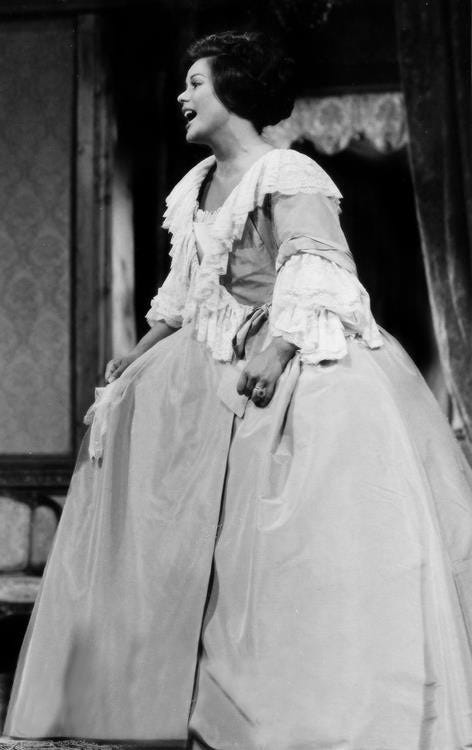
Le Nozze di Figaro, Glyndebourne, 1973
Today we are listening to one of my favorite recordings of The Marriage of Figaro which took place at the Glyndebourne Festival Opera in 1973 with soprano Kiri Te Kanawa, mezzo-soprano Frederica von Stade, soprano Ileana Cotrubaș, and baritones Benjamin Luxon & Knut Skram. Glyndebourne is an opera house based in East Sussex, hosting one of the UK’s most famous opera summer festivals every year.
Shoutout to OD reader “Leibniz” who has mentioned their love for this piece as well.
The performance was over 40 years ago, but it’s a classic like the crisp white shirt hanging in your closet.
The Marriage of Figaro takes place on a single summer’s day in 18th century Seville, Spain. The plot revolves around Susanna and Figaro (FEE-gah-roh), two servants who work in the castle of Count Almaviva, and their quest to be married. The opera features a crazy web of comedy, romance, and mistaken identity as the characters’ relationships unfold over four acts.
Everyone onstage desperately wants something.
Figaro and Susanna, wish to marry, but they will need the Count’s blessing. Count Almaviva wants Susanna as a lover. The Countess only wants to regain the relationship she once had with her husband. She aligns herself with Susanna to persuade (or at least embarrass) the Count into reaffirming their bond.
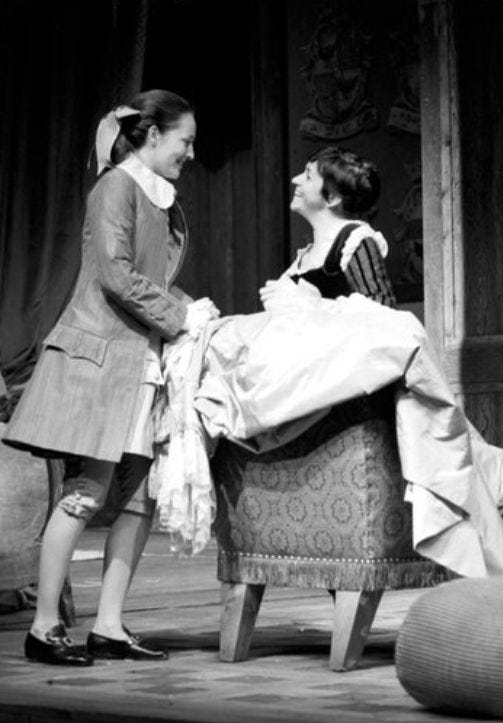
You can watch the entire live performance here.
I am sharing some excerpts below for those who would like the highlights.
🎧 Listening Example (3 minute listen): “Non so piu” from Act 1 of the Italian opera, Le Nozze di Figaro by Wolfgang Amadeus Mozart
After being dismissed from his position as the Count’s page for being discovered alone with the gardener's daughter, Cherubino tells Susanna that, suddenly, every woman excites him to no end.
🎧 Listening Example (3 minute listen): “Voi, che sapete” from Act 2 of the Italian opera, Le Nozze di Figaro by Wolfgang Amadeus Mozart
After Cherubino arrives in his new military uniform, he sings a plea to women to see how much love he has to give.
🎧 Listening Example (5 minute listen): “Dove sono” from Act 3 of the Italian opera, Le Nozze di Figaro by Wolfgang Amadeus Mozart
The Countess sings of her wish that her marriage was happy like it once was.
🎧 Listening Example (3 minute listen): “The Letter Duet” from Act 3 of the Italian opera, Le Nozze di Figaro by Wolfgang Amadeus Mozart
In this duet written for two sopranos, the Countess dictates a letter to her maid, Susanna, to lure the Count (her husband) to a location and catch him in his infidelity.
Do you have a favorite performance of Le Nozze di Figaro? Leave it in the comments, and I will follow up with a YouTube link (if one exists)!
Want more?
Mozart was only 30 years old when he composed The Marriage of Figaro, and he did it in just six weeks. He died five years later, at 35 years old.
The overture of The Marriage of Figaro plays during the opening scene of the movie Trading Places. Typically, an overture showcases various melodies we will eventually hear in the opera, but Mozart does not preview any music from the opera in The Marriage of Figaro overture. Instead, he has written an overture that captures the opera’s pace and atmosphere and celebrates comedy, romance, and music.
The “voice” required to sing Mozart is different from the “voice” that sings, let’s say, Verdi. Verdi’s music has a chunkier orchestra than Mozart’s music does. Mozart wrote music to be sung in a smaller theater (under 1,000 seats) with a smaller orchestra—which means that Verdi’s music is more often than not sung by heavier voices like a full lyric or dramatic sopranos. Many singers can sing both, but the approach to the music can sometimes be very different.
Do you remember The Shawshank Redemption and that scene where the wrongly imprisoned Andy Dufresne (played by Tim Robbins) plays a piece over the loudspeakers, creating a sense of calm throughout the prison yard? Well, this was the letter duet from Figaro—a message of inner freedom regardless of external circumstances. The character of Red in the movie (played by Morgan Freeman), a fellow inmate of Dufresne, provides a voice-over narration during the piece:
“I have no idea to this day what those two Italian ladies were singing about. Truth is, I don’t want to know. Some things are best left unsaid. I’d like to think they were singing about something so beautiful, it can’t be expressed in words, and makes your heart ache because of it…it was like some beautiful bird flapped into our drab little cage and made those walls dissolve away, and for the briefest of moments, every last man in Shawshank felt free.”
Beautiful. And a message that debunks the myth that often gets lost with opera is that you need to understand everything to enjoy it.
Listening to Mozart may not make you smarter, but there is no denying that it changes you.
Merry Christmas week! 🎄🎅☃️🧝🌟
I am thankful for all of you that open this email each week.
Thank you for reading (and listening),
Michele
❤️ Enjoyed this piece? Hit the heart to like it. It helps others find Opera Daily.
📝A reminder that you can check out the complete Opera Daily archives and the playlist on YouTube for more selections. If you were forwarded this email by a friend, join us by subscribing:
My first FIGARO was an amazing Norman Treigle at NYCity Opera; later the stupendous Paris Opera rendition with Solti; Van Dam; Von Stade in Strehler' production. More recently, I saw a really bad one at The Met. Not even Brynn Terfel could save it.
Flicka's performance of "Voi, che sapete" brought back memories. It was my late wife's and my favorite aria ever. When my wife was in John's Hopkins hospital, dying from a coma from which she would never recover, I hummed her that aria. It was the only time that the instruments attached to her registered that she knew what was happening around her. For years after she died, I couldn't bear to listen to that opera, but today hearing that aria just brought back fond memories. I've never thought of a better example of the power of opera.