

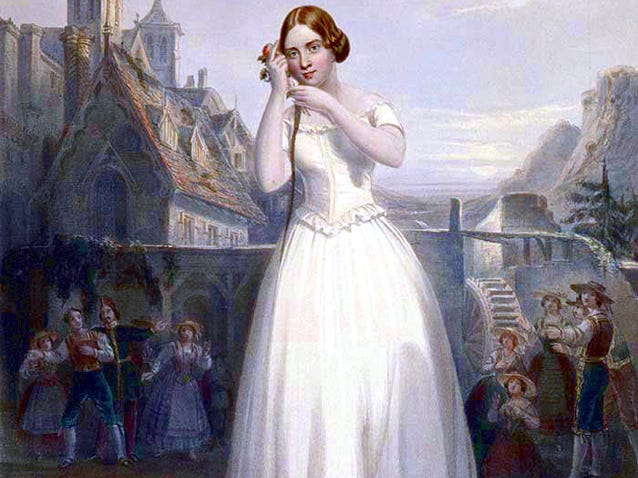
“All of Italian opera can be heard in “Ah! non credea.”
—Renato Scotto
Today we’re listening to…
“Ah! non credea mirarti”, Amina’s aria from Act 2 of the Italian opera La Sonnambula (The Sleepwalker) by Vincenzo Bellini.
In the early 19th century, scientists struggled to understand the phenomenon of sleepwalking (also known as somnambulism). It caused many operas, ballets, and plays to center on this theme, including Verdi’s Macbeth.
Set in a Swiss village in the early nineteenth century, La Sonnambula is the story of Amina whose habit of sleepwalking has scared the villagers, who believe there’s a phantom haunting their village, and risks destroying her relationship with her fiancé Elvino (she climbs into the wrong bed while sleepwalking!).
We are listening to Amina’s “sleepwalking aria”. As she walks (and pretends to sleep!), she sings of her love for Elvino. The villagers witness this—it so happens that she is sleepwalking on the roof of one of the village houses—and leads to her exoneration and the happy reinstatement of her engagement (after her honest mistake!).
🎧 Listen here (8 minute listen): Soprano Anna Moffo singing “Ah! non credea mirarti” from “La Bellissima”, Anna Moffo: The Debut Recordings, EMI Studio, 1956-1959
Ah, non credea mirarti
si presto estinto, o fiore!
Passasti al par d’amore,
che un giorno sol durò.Ah, I didn’t believe I’d see you
Wither so quickly, oh blossom!
You have faded away just like love,
Which only lasted a day.Ah, non giunge uman pensiero
al contento ond’io son piena:
a miei sensi io credo appena;
tu m’affida, o mio tesor!Ah, human thought can’t manage
(To grasp) the depth of my happiness:
I can barely believe my own senses;
You do trust me, oh my darling!
As Renée Fleming mentions in this masterclass with Korean soprano Hyesang Park (where she workshops this aria), the bel canto repertoire is about artistry—it’s what you do with those notes and what you bring to it. Bel canto is a style or way of singing in opera from the mid-18th to early 19th centuries, although it can be traced back to opera’s birth in the 15th century. During this period, composers made it clear that the singer was to take over in any way they pleased.
Bel canto can be intoxicating and it often does this by putting the full spotlight on the voices. There is undoubtedly something formulaic about the music of Donizetti, Bellini, and Rossini, but it works. As you listen to “Ah! non credea mirarti”, you will notice that every run, or note even, is inspired by an emotion the singer is trying to express.
The opera was composed for soprano Giuditta Pasta and tenor Giovanni Battista Rubini, two of the most prominent of the 19th century. It was revived in the 20th century by Maria Callas and Joan Sutherland.
Here are some other interpretations of the piece:
Maria Callas (King's Theatre, Edinburgh, 1957)
Joan Sutherland (New York's Avery Fisher Hall, 1979—it’s fast but exciting )
Pretty Yende (Weill Recital Hall, 2014)
Cecilia Bartoli (The Barcelona Concert, Palau de la Música Catalana, 2008)
Amelita Galli-Curci (Victor recording, 1917)
Ruth Ann Swenson (London Symphony Orchestra)
Want more?
Maria Callas made her mark in the opera world with her mastery of the bel canto style. In 1957, Milan’s famous Teatro alla Scala (La Scala) mounted Bellini’s La Sonnambula at the Edinburgh Festival, with Callas as the star. It was so successful that an extra performance was added, but after it sold out, Callas caused a bit of a scandal—she refused to sing it and left town. The 23- year-old cover, Renata Scotto, had the task of going before the hostile audience, but she had great success that began her long career as one of the world’s leading sopranos.
"Ah! non credea mirarti" is a typical example of the bel canto aria structure (cavatina/cabaletta combination). The cavatina is a generally slow, contemplative aria, designed to show off the singer’s breath control, soft singing (piano) and long vocal line (legato). By contrast to the cavatina, the cabaletta is fast and energetic, designed to show off a singer’s virtuosity and decorative singing.
Gioachino Rossini, Gaetano Donizetti, and Vincenzo Bellini have been called the “three kings of bel canto”.
Bellini had little more than a month to compose La Sonnambula. He used material from his abandoned opera based on Victor Hugo's scandalous drama, Hernani. He began composing in January 1831, and the opera premiered in March 1831 to great success.
The phrase “Ah! non credea mirarti / Sì presto estinto, o fiore” ('“I did not believe you would fade so soon, oh flower”) from Amina’s final aria is inscribed on Bellini’s tomb.
Thank you for reading (and listening),
Michele
❤️ If you enjoyed this selection, hit the heart to like it. It helps others find Opera Daily.
If you missed any of the previous pieces from the past month, catch up here:
I could have happily spent all day and half the night listening to "Oh! se una volta sola...Ah! non credea mirarti ("Ah! non credea")…Ah!non giunge uman pensiero ("Ah!non giunge”)" sung by Amina in Act 2 of Vincenzo Bellini's "La Sonnambula". Instead, I am resolved to see the full opera, in a real opera house, with a singer of the caliber of those highlighted this week. Until then, I'll sample the many productions currently on YouTube - videos, films and especially, the ballet with Mikhail Baryshnikov & Alessandra Ferri (https://www.youtube.com/watch?v=1LpmL_NeiAU).
I wandered down quite a few research lanes before sitting down to gather my thoughts. Before I note my discoveries, I'd like to talk first about my emotions on hearing and watching these extraordinary divas stamp their unique talents on "Ah! non credea mirarti". I will always cherish the sweet voice of Maria Callas in the rare live recording here (https://www.youtube.com/watch?v=l9ZjB_Fj1mM), with its accompanying treasure trove of photographs. La Divina, however, must bow down this time to La Stupenda. Dame Joan Sutherland is in a bel canto class all by herself (https://www.youtube.com/watch?v=KQ7IT5T9ef0). Listening to the latter brought to mind "The Flying Wallendas" walking a tightrope in Times Square without a safety net. Would she really be able to hit those stratospheric high notes? The answer is effortlessly! (https://www.youtube.com/watch?v=NVpuCNd7-s4)!
I adore Pretty Yende who has the mellow tones of Callas, but strained a bit for the high notes. But yes, she can! One only has to listen to her sing "Qui la voce" at the Richard Tucker Gala in 2014 (https://www.youtube.com/watch?v=h_V1RAwDYs8) to know that his gorgeous, glamorous South African sister will not be denied.
For me, the richest, most agile, most bravura performance of "Ah! non credea", was delivered by Cecilia Bartoli (https://www.youtube.com/watch?v=hUi18GyNPlw). Does she have a moniker yet? How about "La Meravigliosa"? "La Favolosa"? As I listened the image of Simone Biles came to mind. Both have that technical perfection, virtuosity, elegance, beauty and lovely diction. I feel I'm slowly acquiring the ability to judge what's good in opera and what's merely aspirational, which is how I would compare Ruth Ann Swenson to the other ladies on your playlist (https://masterworksbroadway.com/artist/ruth-ann-swenson/). I blame Opera Daily for that.🤭
BONUS FIND
*Kathleen Battle's interpretation (https://www.youtube.com/watch?v=CYezkKbEPQw) In "Bel Canto: Kathleen Battle Sings Italian Opera Arias” ℗ 1993 Deutsche Grammophon GmbH, Berlin P.S. I had an exciting musical moment using my unsophisticated technique to mix her Amina with Cecilia Bartoli’s.
There was so much to savor in this week's post:
(1) the 1850 portrait of Jenny Lind, "The Swedish Nightingale", as Amina;
(2) the introduction to the great Amelita Galli-Curci (https://www.youtube.com/watch?v=-Ybtj8g-5kw_)
(3) the explanation of the bel canto structure
(4) all the fun facts; the three kings of bel canto opera (Bellini, Donizetti, Verdi); Renata Scotto rising to fame as a last-minute replacement for Maria Callas; Bellini creating "La Sonnambula" with music borrowed from his "abandoned" opera "Hernani" based on a "scandalous drama” by Victor Hugo; and finally, the engraving on Bellini's tombstone: “Ah! non credea mirarti/Sì presto estinto, o fiore” ('“I did not believe you would fade so soon, oh flower”) from Amina’s final aria.
EXTRA! EXTRA!
*Vincenzo Bellini (https://www.allmusic.com/artist/vincenzo-bellini-mn0000646795/biography;https://en.wikipedia.org/wiki/Vincenzo_Bellini)
*Amelita Galli-Curci (https://www.allmusic.com/artist/amelita-galli-curci-mn0001268426; https://en.wikipedia.org/wiki/Amelita_Galli-Curci**)
*Ruth Ann Swenson (https://masterworksbroadway.com/artist/ruth-ann-swenson/; https://en.wikipedia.org/wiki/Ruth_Ann_Swenson)
*Hernani (full name “Hernani, ou l'Honneur Castillan”) by French romantic novelist Victor Hugo is a drama in rhyming alexandrines, a syllabic poetic meter typically of 12 syllables with a medial caesura [a metrical pause or break in a verse where one phrase ends and another phrase begins, dividing the verse into two hemistiches (half-lines) of six syllables each]
*Sleepwalking (https://en.wikipedia.org/wiki/Sleepwalking;https://www.mayoclinic.org/diseases-conditions/sleepwalking/symptoms-causes/syc-20353506)
PERILS OF OPERA
Galli-Curci’s Voice (https://en.wikipedia.org/wiki/Amelita_Galli-Curci)
“Weary of opera house politics and convinced that opera was a dying art form, Galli-Curci retired from the operatic stage in 1930 to concentrate instead on concert performances. Throat problems and the uncertain pitching of top notes had plagued her for several years, and she underwent surgery in 1935for the removal of a thyroid goiter. Great care was taken during her surgery, which was performed under local anesthesia; however, it was thought her voice suffered following the surgery, specifically, a nerve to her larynx, the external branch of the superior laryngeal nerve, was thought to have been damaged, resulting in the loss of her ability to sing high pitches. This nerve has since become known as the “nerve of Galli-Curci.”
In 2001, researchers Crookes and Recaberen "examined contemporary press reviews after surgery, conducted interviews with colleagues and relatives of the surgeon, and compared the career of Galli-Curci with that of other singers" and determined that her vocal decline was most likely not caused by a surgical injury.[5]
Other researchers (Marchese-Ragona et al.) have argued that tracheal compression caused by a goiter put an early end to Galli-Curci's career as a coloratura soprano, but it was nerve damage caused during surgery that prevented her from prolonging her career as lyric or dramatic soprano.”
I segued into “Best of Opera” while writing (https://www.youtube.com/watch?v=DrITKSRCqGo). I soon realized I had heard many of these arias for the first time through Opera Daily. Occasionally I recognized an artist, or an opera, but couldn’t come up with the name of the aria. This recording and track list will help me achieve true aria literacy someday.
In conclusion, Bellini must be my spirit opera composer. I’ve really gotten carried away here. It is, nevertheless, time to bring this flight of fancy in for a landing.🕊💗🥂
Took my breath away.. beautifully sung by Anna Moffo